Today's
EarthStation1.com 15% Off Commemorative Memorial Title: Fibber
McGee And Molly Complete Radio Series MP3 DVD, Download, USB
Today, January 22, 2025
January 22: National Hot Sauce Day: -- A
day to tingle your tastebuds with this spicy condiment, sample
sauces from all over the world or challenge your friends to try
the hotter varieties. Are you more of a Tabasco person, or are the
spicy chili peppers of Southeast Asia the ones that get your mouth
watering? Should hotness be combined with salty flavors or rather
sweet ones? Whatever you believe and whatever your preferences, if
you are one of those people who feels that "spicy" is
never quite spicy enough, National Hot Sauce Day is the perfect
day for you! Humans started using chili peppers and other such
spices thousands of years ago, with many historians believing that
chili peppers were one of the earliest plants harvested by humans.
Back in this era, historians believe the recipe was a simple
mixture of peppers and water mixed into a liquid or thick paste.
In South and Central America, there is evidence of chili peppers
being used for cooking as early as 6,000 years ago, but they did
not reach Europe until the 16th century when Portuguese and
Spanish explorers began sending all sorts of unusual foods from
the New World back home. The first hot sauce to be available in a
bottle appeared in shops in the state of Massachusetts in the year
1807, and then suddenly, hot sauce was everywhere and being added
to everything. Tabasco sauce is one of the earliest brands to have
come into existence that still exists today, being bottled and
sold for the first time in 1868. Today's recipes contain a wide
variety of peppers, and many food enthusiasts argue passionately
about which pepper makes the best sauce. Some of the most commonly
used peppers are jalapenos, reapers, Thai chilies, cayenne
peppers, serranos, and ghost peppers. The hottest pepper in the
world is often considered to be the Carolina Reaper, with a
Scoville rating of 2,000,000 (the average jalapeno pepper ranking
at only 3,500 Scoville Heat Units)! National Hot Sauce Day was
founded to get people excited about the amazing accessory that hot
sauce is to any meal! On Sale @ 15% Off Discount Till Midnight PT!
https://store.earthstation1.com/fibber-mcgee-and-molly-mp3-dvd-complete-radio-serie3.html
Today's
EarthStation1.com 15% Off Commemorative Memorial Title: The Bad
Lord Byron (1949) Docudramatic Biography DVD, MP4, USB Drive
Today, January 22, 2025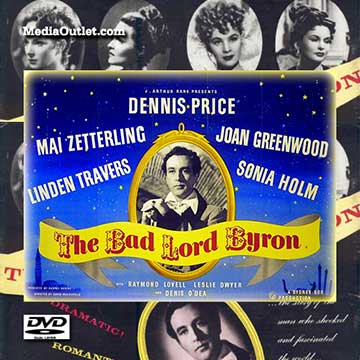
January 22, 1788: #BOTD: #HBD! George Gordon Byron, 6th Baron Byron FRS, most well known as Lord Byron, English nobleman, soldier, poet, peer, politician, playwright and leading figure in the Romantic movement (d. April 19, 1824) is #born George Gordon Byron on Holles Street in London, England, now supposedly occupied by a branch of the department store John Lewis. George Gordon Byron, 6th Baron Byron, is regarded as one of the greatest British poets and remains widely read and influential. Among his best-known works are the lengthy narrative poems Don Juan and Childe Harold' Pilgrimage as well as the short lyric poem "She Walks in Beauty". He travelled extensively across Europe, especially in Italy, where he lived for seven years in the cities of Venice, Ravenna and Pisa. During his stay in Italy he frequently visited his friend and fellow poet Percy Bysshe Shelley. Often described as the most flamboyant and notorious of the major Romantics, Byron was both celebrated and castigated in his life for his aristocratic excesses, including huge debts, numerous love affairs with both men and women, as well as rumors of a scandalous liaison with his half-sister. His only legitimate child, Ada Lovelace, is regarded as the first computer programmer based on her notes for Charles Babbage' Analytical Engine. Byron' illegitimate children include Allegra Byron, who died in childhood, and possibly Elizabeth Medora Leigh. Later in life Byron joined the Greek War of Independence fighting the Ottoman Empire, for which Greeks revere him as a national hero. Lord Byron died of fever in Missolonghi, Greece, while serving as an officer in the Greek War Of Independence against the Ottoman Empire, aged 36. As of 2008, the anniversary of Byron's death has been honoured in Greece as "Byron Day". Upon his death, the barony passed to Byron's cousin George Anson Byron, a career naval officer. Alfred Tennyson would later recall the shocked reaction in Britain when word was received of Byron's death. The Greeks mourned Lord Byron deeply, and he became a hero. The national poet of Greece, Dionysios Solomos, wrote a poem about the unexpected loss, named To the Death of Lord Byron. "Vyron", the Greek form of "Byron", continues in popularity as a masculine name in Greece, and a suburb of Athens is called Vyronas in his honour. Byron's body was embalmed, but the Greeks wanted some part of their hero to stay with them. According to some sources, his heart remained at Missolonghi. His other remains were sent to England (accompanied by his faithful manservant, "Tita") for burial in Westminster Abbey, but the Abbey refused for reason of "questionable morality". Huge crowds viewed his coffin as he lay in state for two days at number 25 Great George Street, Westminster. He is buried at the Church of St. Mary Magdalene in Hucknall, Nottinghamshire. A marble slab given by the King of Greece is laid directly above Byron's grave. His daughter Ada Lovelace was later buried beside him. Byron's friends raised 1K PS to commission a statue of the writer; Thorvaldsen offered to sculpt it for that amount. However, after the statue was completed in 1834, for ten years, British institutions turned it down and it remained in storage. It was refused by the British Museum, St. Paul's Cathedral, Westminster Abbey and the National Gallery before Trinity College, Cambridge finally placed the statue of Byron in its library. In 1969, 145 years after Byron's death, a memorial to him was finally placed in Westminster Abbey. As of 1907, The New York Times wrote, "People are beginning to ask whether this ignoring of Byron is not a thing of which England should be ashamed ... a bust or a tablet might be put in the Poets' Corner and England be relieved of ingratitude toward one of her really great sons." Robert Ripley, American cartoonist, entrepreneur, and amateur anthropologist, who is known for creating the Ripley's Believe It or Not! newspaper panel series, television show, and radio show, which feature odd facts from around the world, had drawn a picture of the grave of Lord Byron's Landseer dog Boatswain, whom Byron reportedly nursed him without any fear of becoming bitten and infected by the rabies that killed him, and of whom Byron wrote the poem "Epitaph To A Dog" (also known as "Inscription On The Monument To A Newfoundland Dog"). Riply captioned his drawing with the words "Lord Byron's dog has a magnificent tomb while Lord Byron himself has none". This came as a shock to the English, particularly schoolchildren, who, Ripley said, raised funds of their own accord to provide the poet with a suitable memorial. After arriving in Missolonghi, Byron moved to the second floor of a two-story house there and joined forces with Alexandros Mavrokordatos, a Greek politician with military power. Mavrokordatos and Byron planned to attack the Turkish-held fortress of Lepanto, at the mouth of the Gulf of Corinth. Byron employed a fire master to prepare artillery, and he took part of the rebel army under his own command despite his lack of military experience. Before the expedition could sail, on February 15, 1824, he fell ill, and bloodletting weakened him further. He made a partial recovery, but in early April he caught a violent cold; the therapeutic bleeding insisted on by his doctors exacerbated it. He thereby contracted a violent fever and died. His physician at the time, Julius van Millingen, son of Dutch-English archaeologist James Millingen, was unable to prevent his death. It has been said that if Byron had lived and had gone on to defeat the Ottomans, he might have been declared King of Greece. However, modern scholars have found such an outcome unlikely. The British historian David Brewer wrote that in one sense, Byron failed to persuade the rival Greek factions to unite, won no victories and was successful only in the humanitarian sphere, using his great wealth to help the victims of the war, Christian and Muslim, but this did not affect the outcome of the Greek war of independence. Close to the centre of Athens, Greece, outside the National Garden, is a statue depicting Greece in the form of a woman crowning Byron. The statue is by the French sculptors Henri-Michel Chapu and Alexandre Falguiere. On Sale @ 15% Off Discount Till Midnight PT! https://store.earthstation1.com/the-bad-lord-byron-19491949.html
Today's
EarthStation1.com 15% Off Commemorative Memorial Title: Birth Of A
Nation (1915) D. W. Griffith DVD, MP4 Download, USB Stick
Today, January 22, 2025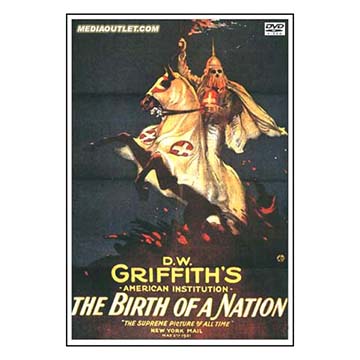
January 22, 1875: #BOTD: #HBD! D. W.
Griffith, American actor, director, producer, screenwriter and
Freemason, one of the most important figures in the history of
film who pioneered modern cinematic techniques and popularized the
use of the close-up shot, co-founder of United Artists, and
co-founder of the Academy Of Motion Picture Arts And Sciences;
most remembered for The Birth of a Nation (1915) and Intolerance
(1916), the former making use of advanced camera and narrative
techniques, and whose popularity set the stage for the dominance
of the feature-length film in the United States and sparked
significant controversy surrounding racism in the United States,
focusing on its negative depiction of black people and the
glorification of the Ku Klux Klan (d. July 23, 1948) is #born
David Wark Griffith on a farm in Oldham County, Kentucky, the son
of Jacob Wark "Roaring Jake" Griffith, a Confederate
Army colonel in the American Civil War who was elected as a
Kentucky state legislator, and Mary Perkins (nee Oglesby). The
Birth of a Nation is both acclaimed for its radical technique and
condemned for its inherently racist philosophy. The film was
subject to boycotts by the NAACP; screenings caused riots at
several theaters and it was censored in many cities, including New
York City. Intolerance was an answer to his critics. Several of
Griffith's later films were also successful, including Broken
Blossoms (1919), Way Down East (1920), and Orphans of the Storm
(1921), but his high costs for production, promotion, and roadshow
often made his ventures commercial failures. He made roughly 500
films by the time of his final feature The Struggle (1931). D. W.
Griffith died unconscious at 3:42 PM in the lobby at the
Knickerbocker Hotel in Los Angeles, California here he had been
living alone of a cerebral hemorrhage on the way to a Hollywood
hospital. A public memorial service was held in his honor at the
Hollywood Masonic Temple. He is buried at Mount Tabor Methodist
Church Graveyard in Centerfield, Kentucky. In 1950, The Directors
Guild of America provided a stone and bronze monument for his
grave site. On Sale @ 15% Off Discount Till Midnight PT!
https://store.earthstation1.com/birth-of-a-nation-dvd-d-w-griffith-civil-war-movie.html
Today's
EarthStation1.com 15% Off Commemorative Memorial Title: The Secret
Life Of Sergei Eisenstein Documentary MP4 Download Or DVD
Today, January 22, 2025
January 22, 1898: #BOTD: #HBD! Sergei
Eisenstein, Latvian Soviet film director (d. February 11, 1948) is
#born Sergei Mikhailovich Eisenstein in Riga, Latvia. Sergei
Eisenstein was a film theorist, a pioneer in the theory and
practice of montage. He is noted in particular for his silent
films Strike (1925), Battleship Potemkin (1925) and October
(1928), as well as the historical epics Alexander Nevsky (1938)
and Ivan The Terrible (1944, 1958). He developed a new way of film
making utilizing artistic montages (a series of arbitrary images)
to deliver an emotional impact. Prior to him, most film makers
showed scenes in strictly chronological sequences. Eisenstein died
of a heart attack in Moscow, Russian SFSR, Soviet Union at the age
of 50. His body lay in state in the Hall of the Cinema Workers
before being cremated on February 13, and his ashes were buried in
the Novodevichy Cemetery in Moscow. On Sale @ 15% Off Discount
Till Midnight PT!
https://store.earthstation1.com/the-secret-life-of-sergei-eisenstein-documentary-dvd.html
Today's
EarthStation1.com 15% Off Commemorative Memorial Title: The
Monarchy: British Royal Family History TV Series DVD MP4 USB Drive
Today, January 22, 2025
January 22, 1901: #DOTD: #RIP: The
Victorian Era of British history ends as Queen Victoria Of
England, Queen Of The United Kingdom Of Great Britain And Ireland
from June 20, 1837 and Empress of India from May 1, 1876 until her
death (b. May 24, 1819) #dies at half past six in the evening at
the age of 81 at Osborne House, Isle of Wight, England, after
having reigned for 64 years, the longest reign in British history
until that time. She is buried at The Royal Mausoleum, Frogmore on
the Frogmore estate within the Home Park at Windsor in Berkshire,
England. She was born Alexandrina Victoria Hanover, the daughter
of Prince Edward, Duke of Kent and Strathearn, the fourth son of
King George III. Both the Duke of Kent and King George III died in
1820, and Victoria was raised under close supervision by her
German-born mother, Princess Victoria of Saxe-Coburg-Saalfeld. She
inherited the throne at the age of 18, after her father' three
elder brothers had all died, leaving no surviving legitimate
children. The United Kingdom was already an established
constitutional monarchy, in which the sovereign held relatively
little direct political power. Privately, Victoria attempted to
influence government policy and ministerial appointments;
publicly, she became a national icon who was identified with
strict standards of personal morality. Victoria married her first
cousin, Prince Albert Of Saxe-Coburg And Gotha, in 1840. Their
nine children married into royal and noble families across the
continent, tying them together and earning her the sobriquet "the
grandmother of Europe". After Albert' death in 1861, Victoria
plunged into deep mourning and avoided public appearances. As a
result of her seclusion, republicanism temporarily gained
strength, but in the latter half of her reign her popularity
recovered. Her Golden and Diamond Jubilees were times of public
celebration. Her reign of 63 years and seven months was longer
than that of any of her predecessors, and is known as the
Victorian era. It was a period of industrial, cultural, political,
scientific, and military change within the United Kingdom, and was
marked by a great expansion of the British Empire. She was the
last British monarch of the House Of Hanover. Her son and
successor, Edward VII, initiated the House Of Saxe-Coburg And
Gotha, the line of his father. #QueenVictoria
#QueenOfTheUnitedKingdom #QueenOfGreatBritain #QueenOfIreland
#MonarchyOfTheUnitedKingdom #MonarchyOfTheUK #HouseOfHanover
#UnitedKingdom #India #Pakistan #EmpressOfIndia #BritishMonarchy
#BritishNobility #UKMonarchy #MP4 #VideoDownload #DVD On Sale @
15% Off Discount Till Midnight PT!
https://store.earthstation1.com/the-monarchy-3-part-british-royal-family-tv-series-dvd-mp4-u34.html
Today's
EarthStation1.com 15% Off Commemorative Memorial Title: La Belle
Epoque 1890-1914 DVD, MP4 Video Download, USB Flash Drive
Today, January 22, 2025
January 22, 1901: The History Of The
United Kingdom: Governments Of The United Kingdom: Royal
Accessions: Successions To The British Throne: -- The Edwardian
Era of British history begins as Albert Edward Saxe-Coburg-Gotha,
son of Queen Victoria and Prince Consort Albert of Saxe-Coburg and
Gotha, becomes King Of The United Kingdom of Great Britain and
Ireland and Emperor Of India (and, in an innovation at the time,
King of the British Dominions) upon the death of his mother Queen
Victoria, and reigns under the name of Edward VII, instead of
Albert Edward, the name his mother had intended for him to use,
declaring that he did not wish to "undervalue the name of
Albert" and diminish the status of his father with whom the
"name should stand alone". The numeral VII was
occasionally omitted in Scotland, even by the national church, in
deference to protests that the previous Edwards were English kings
who had "been excluded from Scotland by battle". J. B.
Priestley recalled, "I was only a child when he succeeded
Victoria in 1901, but I can testify to his extraordinary
popularity. He was in fact the most popular king England had known
since the earlier 1660s." Edward donated his parents' house,
Osborne on the Isle of Wight, to the state and continued to live
at Sandringham. He could afford to be magnanimous; his private
secretary, Sir Francis Knollys, claimed that he was the first heir
to succeed to the throne in credit. Edward's finances had been
ably managed by Sir Dighton Probyn, Comptroller of the Household,
and had benefited from advice from Edward's financier friends,
some of whom were Jewish, such as Ernest Cassel, Maurice de Hirsch
and the Rothschild family. At a time of widespread anti-Semitism,
Edward attracted criticism for openly socialising with Jews.
Edward's coronation had originally been scheduled for June 26,
1902. However, two days before, he was diagnosed with
appendicitis. The disease was generally not treated operatively.
It carried a high mortality rate, but developments in anaesthesia
and antisepsis in the preceding 50 years made life-saving surgery
possible. Sir Frederick Treves, with the support of Lord Lister,
performed a then-radical operation of draining a pint of pus from
the infected abscess through a small incision (through 4+1/2-inch
thickness of belly fat and abdomen wall); this outcome showed that
the cause was not cancer. The next day, Edward was sitting up in
bed, smoking a cigar. Two weeks later, it was announced that he
was out of danger. Treves was honoured with a baronetcy (which the
King had arranged before the operation) and appendix surgery
entered the medical mainstream. Edward was crowned at Westminster
Abbey on August 9, 1902 by the 80-year-old Archbishop of
Canterbury, Frederick Temple, who died only four months later.
Edward refurbished the royal palaces, reintroduced the traditional
ceremonies, such as the State Opening of Parliament, that his
mother had foregone, and founded new honours, such as the Order of
Merit, to recognise contributions to the arts and sciences. In
1902, the Shah of Persia, Mozzafar-al-Din, visited England
expecting to receive the Order of the Garter. The King refused to
bestow the honour on the Shah because the order was meant to be in
his personal gift and the Foreign Secretary, Lord Lansdowne, had
promised it without his consent. He also objected to inducting a
Muslim into a Christian order of chivalry. His refusal threatened
to damage British attempts to gain influence in Persia, but Edward
resented his ministers' attempts to reduce his traditional powers.
Eventually, he relented and Britain sent a special embassy to the
Shah with a full Order of the Garter the following year. Edward
VII, King Of The United Kingdom of Great Britain and Ireland and
Emperor Of India, from January 22 1901 until his death (d. May 6,
1910) was born Albert Edward Saxe-Coburg-Gotha on November 9, 1841
at Buckingham Palace, London, England. The second child and eldest
son of Queen Victoria and Prince Albert of Saxe-Coburg and Gotha,
and nicknamed "Bertie", Edward was related to royalty
throughout Europe. He was Prince of Wales and heir apparent to the
British throne for almost 60 years. During the long reign of his
mother, he was largely excluded from political influence and came
to personify the fashionable, leisured elite. He travelled
throughout Britain performing ceremonial public duties and
represented Britain on visits abroad. His tours of North America
in 1860 and of the Indian subcontinent in 1875 proved popular
successes, but despite public approval, his reputation as a
playboy prince soured his relationship with his mother. As king,
Edward played a role in the modernisation of the British Home
Fleet and the reorganisation of the British Army after the Second
Boer War of 1899-1902. He re-instituted traditional ceremonies as
public displays and broadened the range of people with whom
royalty socialised. He fostered good relations between Britain and
other European countries, especially France, for which he was
popularly called "Peacemaker", but his relationship with
his nephew, the German Emperor Wilhelm II, was poor. The Edwardian
era, which covered Edward's reign and was named after him,
coincided with the start of a new century and heralded significant
changes in technology and society, including steam turbine
propulsion and the rise of socialism. A heavy smoker who suffered
from chronic bronchitis, he suffered several heart attacks in a
single day, but refused to go to bed to recuperate, saying, "No,
I shall not give in; I shall go on; I shall work to the end."
Between moments of faintness, his son the Prince of Wales (shortly
to be King George V) told him that his horse, Witch of the Air,
had won at Kempton Park that afternoon. The King replied, "Yes,
I have heard of it. I am very glad": his final words. At
11:30 p.m. he lost consciousness for the last time and was put to
bed. He died 15 minutes later. Alexandra refused to allow Edward's
body to be moved for eight days afterwards, though she allowed
small groups of visitors to enter his room. On May 11, the late
king was dressed in his uniform and placed in a massive oak
coffin, which was moved on May 14 to the throne room, where it was
sealed and lay in state, with a guardsman standing at each corner
of the bier. Despite the time that had elapsed since his death,
Alexandra noted the King's body remained "wonderfully
preserved". On the morning of May 17, the coffin was placed
on a gun carriage and drawn by black horses to Westminster Hall,
with the new king, his family and Edward's favourite dog, Caesar,
walking behind. Following a brief service, the royal family left,
and the hall was opened to the public; over 400,000 people filed
past the coffin over the next two days. As Barbara Tuchman noted
in The Guns of August, his funeral, held on 20 May 1910, marked
"the greatest assemblage of royalty and rank ever gathered in
one place and, of its kind, the last." A royal train conveyed
the King's coffin from London to Windsor Castle, where Edward was
buried at St George's Chapel. Edward was succeeded by his only
surviving son, George V. On Sale @ 15% Off Discount Till Midnight
PT!
https://store.earthstation1.com/la-belle-epoque-18901914-western-high-society-cul18901914.html
Today's
EarthStation1.com 15% Off Commemorative Memorial Title: TV Music &
Dance Shows #6 Shindig DVD, Video Download, USB Flash Drive
Today, January 22, 2025
January 22, 1931: #BOTD: #HBD! Sam Cooke,
nicknamed "The King Of Soul" for his distinctive vocals
and importance within popular music, influential African American
singer, songwriter, and entrepreneur (d. December 11, 1964) is
#born Samuel Cook in Clarksdale, Mississippi; he added the "e"
to his last name in 1957 to signify a new start to his life. He
began singing as a child and joined The Soul Stirrers before
moving to a solo career where he scored a string of hit songs like
"You Send Me", "Wonderful World", "Chain
Gang", and "Twistin' the Night Away". His
pioneering contributions to soul music contributed to the rise of
Aretha Franklin, Bobby Womack, Al Green, Curtis Mayfield, Stevie
Wonder, Marvin Gaye, and Billy Preston, and popularized the likes
of Otis Redding and James Brown. AllMusic biographer Bruce Eder
wrote that Cooke was "the inventor of soul music", and
possessed "an incredible natural singing voice and a smooth,
effortless delivery that has never been surpassed". Sam Cooke
died at the age of 33, shot and killed by Bertha Franklin, the
manager of the Hacienda Motel in Los Angeles, California. After an
inquest, the courts ruled Cooke's death to be a justifiable
homicide. Since that time, the circumstances of his death have
been called into question by Cooke's family. He is buried at
Forest Lawn Memorial Park in Glendale, California. On Sale @ 15%
Off Discount Till Midnight PT!
https://store.earthstation1.com/classic-tv-music-amp-dance-shows-6-shindig-dv6.html
Today's
EarthStation1.com 15% Off Commemorative Memorial Title: The Good
Old Time TV Theme Song MP3 CD, Audio Download, USB Drive
Today, January 22, 2025
January 22, 1934: #BOTD: #HBD! Bill
Bixby, American actor, director, producer, and frequent game-show
panelist (d. November 21, 1993) is #born Wilfred Bailey Everett
Bixby III, a fourth-generation Californian of English descent, on
January 22, 1934, in San Francisco, California. His father,
Wilfred Everett Bixby II, was a store clerk and his mother, Jane
(nee McFarland) Bixby, was a senior manager at I. Magnin &
Company, a San Francisco, California-based high fashion and
specialty goods luxury department store. Bill Bixby's career
spanned more than three decades, including appearances on stage,
in films, and on television series. He is known for his roles as
Tim O'Hara in the CBS sitcom My Favorite Martian, Tom Corbett in
the ABC sitcom The Courtship of Eddie's Father, and stage
illusionist Anthony Blake in the NBC crime drama series The
Magician, but is perhaps best known for his role as scientist Dr.
David Banner in the CBS science-fiction drama series The
Incredible Hulk. Bixby died in 1993 of complications from prostate
cancer in Century City, Los Angeles at the age of 59. His remains
were cremated, and the ashes given to his widow Judith Kliban, who
scattered them in the Pacific Ocean. #BillBixby #Actors #Directors
#Producers #GameShowPanelists #TV #Television #TVShows
#TelevisionShows #MyFavoriteMartian #TheCourtshipOfEddiesFather
#TheMagicianAmericanTVSeries #TheIncredibleHulk1978TVSeries #MP3
#CD #AudioDownload On Sale @ 15% Off Discount Till Midnight PT!
https://store.earthstation1.com/tv-theme-song-mp3-cd-classic-old-time-televisio3.html
Today's
EarthStation1.com 15% Off Commemorative Memorial Title: World War
II: The War Years 17 Part TV Series MP4 Video Download DVD
Today, January 22, 2025
January 22, 1941: World War II: The
Battle Of Tobruk (1941): British and Commonwealth troops capture
Tobruk from Italian forces during Operation Compass. Operation
Compass was the first large Allied military operation of the
Western Desert Campaign (1940-1943) during the Second World War.
British and other Commonwealth forces attacked Italian forces in
western Egypt and Cyrenaica, the eastern province of Libya, from
December 1940 to February 1941, with great success. The Western
Desert Force (Lieutenant-General Richard O'Connor) with about
30,000 men, advanced from Mersa Matruh in Egypt on a five-day raid
against the Italian positions of the 10th Army (Marshal Rodolfo
Graziani), which had about 150,000 men in fortified posts around
Sidi Barrani and in Cyrenaica. The 10th Army was swiftly defeated
and the British continued the operation, to pursue the remnants of
the 10th Army to Beda Fomm and El Agheila on the Gulf of Sirte.
The British took 138,000 Italian and Libyan prisoners, hundreds of
tanks and over 1,000 guns and aircraft for a loss of 1,900 men
killed and wounded, about 10 percent of their infantry. The
British were unable to continue beyond El Agheila, due to broken
down and worn out vehicles and the diversion, beginning in March
1941, of the best-equipped units to the Greek Campaign in
Operation Lustre. On Sale @ 15% Off Discount Till Midnight PT!
https://store.earthstation1.com/world-war-ii-the-war-years-17-part-tv-series-mp4-video-download-174.html
Today's
EarthStation1.com 15% Off Commemorative Memorial Title: Axis
Armor: Tanks Of Nazi Germany Japan & Italy MP4 Video Download
DVD
Today, January 22, 2025
January 22, 1943: The European Civil War:
World War II: The Second European War (The European Theater Of
World War II): The North African Campaign: The Western Desert
Campaign (The Desert War): The Battle Of Tripoli: -- On the first
day of the two-day battle, the British 8th Army, a Commonwealth
force commanded by Sir Bernard Montgomery attack Der
Deutsch-Italienische Panzerarmee (The German-Italian Panzer Army),
a combination of the German Afrika Korps with Italian units
commanded by Erwin Rommel of Germany and Ettore Bastico of Italy,
who held the town of Tripoli in Italian Libya. After a short
siege, the Italian and German forces withdrew from Tripoli on
January 23, 1943, and the Allies entered the town to great
worldwide fanfare. Tripoli was from then on governed by the
British until independence in 1951. Under the terms of the 1947
peace treaty with the Allies, Italy relinquished all claims to
Libya. Tripoli had been controlled by Italy from 1911 until the
provinces of Tripolitania and Cyrenaica were captured by Allied
forces. On Sale @ 15% Off Discount Till Midnight PT!
https://store.earthstation1.com/axis-armor-tanks-of-nazi-germany-japan-amp-italy-mp4-video-download-dv4.html
Today's
EarthStation1.com 15% Off Commemorative Memorial Title: Battleline
(1963) WWII TV Documentary Series DVD, Download, USB Drive
Today, January 22, 2025
January 22, 1944: The European Civil War:
World War II: The Second European War (The European Theater Of
World War II): The Mediterranean And Middle East Theater Of World
War II: The Italian Campaign Of World War II (The Liberation Of
Italy): The Winter Line: The Battle Of Rome (The Liberation Of
Rome): The Battle Of Anzio (Operation Shingle): -- An Allied
amphibious landing assault on Anzio and Nettuno, Italy commence
Operation Shingle (The Battle of Anzio), a battle of the Italian
Campaign of World War II that lasted until June 5, 1944, ending
with the capture of Rome. The operation was opposed by German
forces in the area of Anzio and Nettuno. The operation was
initially commanded by Major General John P. Lucas, of the U.S.
Army, commanding U.S. VI Corps with the intention being to
outflank German forces at the Winter Line and enable an attack on
Rome. On Sale @ 15% Off Discount Till Midnight PT!
https://store.earthstation1.com/battleline-wwii-tv-documentary-series-5-dual-layer-dvd5.html
Today's
EarthStation1.com 15% Off Commemorative Memorial Title: Secret
Intelligence: US Espionage History TV Series DVD MP4 USB
Today, January 22, 2025
January 22, 1946: The Aftermath Of World
War II: The Cold War: Global Surveillance: The United States
Department Of Defense (DoD, USDOD, DOD): Intelligence Agencies: --
The Central Intelligence Group, forerunner of the Central
Intelligence Agency, is created. The success of the British
Commandos during World War II prompted U.S. President Franklin D.
Roosevelt to authorize the creation of an intelligence service
modeled after the British Secret Intelligence Service (MI6), and
Special Operations Executive. This led to the creation of the
Office of Strategic Services (OSS) established by a Presidential
military order issued by President Roosevelt on June 13, 1942. On
September 20, 1945, shortly after the end of World War II, Harry
S. Truman signed an executive order dissolving the OSS, and by
October 1945 its functions had been divided between the
Departments of State and War. The division lasted only a few
months. The first public mention of the "Central Intelligence
Agency" appeared on a command-restructuring proposal
presented by Jim Forrestal and Arthur Radford to the U.S. Senate
Military Affairs Committee at the end of 1945. Army Intelligence
agent Colonel Sidney Mashbir and Commander Ellis M. Zacharias
worked together for four months at the direction of Fleet Admiral
Joseph Ernest King, and prepared the first draft and implementing
directives for the creation of what would become the Central
Intelligence Agency. Despite opposition from the military
establishment, the United States Department of State and the
Federal Bureau of Investigation (FBI), Truman established the
National Intelligence Authority in January 1946. Its operational
extension was known as the Central Intelligence Group (CIG), which
was the direct predecessor of the CIA. On Sale @ 15% Off Discount
Till Midnight PT!
https://store.earthstation1.com/secret-intelligence-us-espionage-history-tv-series-dvd-mp4-us4.html
Today's
EarthStation1.com 15% Off Commemorative Memorial Title: KTLA: The
First 35 Years: Los Angeles TV Station Channel 5 MP4 Or DVD
Today, January 22, 2025
January 22, 1947: Premieres: Television
Premieres: -- KTLA, the first commercial television station west
of the Mississippi River, begins operation in Hollywood. KTLA,
virtual channel 5 (UHF digital channel 31), is a CW-affiliated
television station located in Los Angeles, California, United
States. The station is owned by the Tribune Broadcasting
subsidiary of Tribune Media. KTLA maintains studio facilities
located at the Sunset Bronson Studios (formerly The Old Warner
Brothers Studio, KTLA Studios and Tribune Studios, where the first
talking feature film, The Jazz Singer was filmed in 1927) on
Sunset Boulevard in Hollywood, and its transmitter is located atop
Mount Wilson, located within the San Gabriel Mountains National
Monument and Angeles National Forest in Los Angeles County,
California. On Sale @ 15% Off Discount Till Midnight PT!
https://store.earthstation1.com/ktla-the-first-35-years-tv-channel-5-la-355.html
Today's
EarthStation1.com 15% Off Commemorative Memorial Title: The
Exorcism: First TV Broadcast Of An Actual Exorcism DVD, MP4, USB
Today, January 22, 2025
January 22, 1959: #BOTD: #HBD! Linda
Blair, American actress, animal rights activist and beauty, is
#born Linda Denise Blair in St. Louis, Missouri. She played Regan
MacNeil in the horror film The Exorcist (1973), for which she won
a Golden Globe Award and received a nomination for an Academy
Award. The film established her as a horror icon and scream queen;
she reprised the role in the sequel Exorcist II: The Heretic
(1977), for which she earned a nomination for a Saturn Award.
Blair went on to star in numerous television films, such as Born
Innocent (1974), Sarah T. - Portrait of a Teenage Alcoholic
(1975), and Stranger in Our House (1978), before establishing
herself as a sex symbol in the musical film Roller Boogie (1979).
The 1980s had her starring in numerous horror and exploitation
films, including the slasher Hell Night (1981), the prison drama
Chained Heat (1983), and the grindhouse cult thriller Savage
Streets (1984). Throughout the 1990s, Blair appeared in various
independent films and B movies, as well as several television
credits. She was the host of the Fox Family reality series
Scariest Places on Earth (2000-2006) and had regular appearances
on the Animal Planet series Pit Boss (2010-2012). Blair is a
prominent activist for the animal rights movement. In 2004, she
founded the Linda Blair WorldHeart Foundation, a nonprofit
organization that serves to rehabilitate and adopt rescue animals.
A vegan, she co-authored the book Going Vegan! in 2001. On Sale @
15% Off Discount Till Midnight PT!
https://store.earthstation1.com/the-exorcism-1991-history39s-first-tv-broadcast-of-possessed-pers199139.html
Today's
EarthStation1.com 15% Off Commemorative Memorial Title: De Gaulle
And France TV Series DVD, Video Download, USB Flash Drive
Today, January 22, 2025
January 22, 1963: France: The History Of
France: The Modern History Of France: The Presidency Of Charles De
Gaulle: Treaties Of Friendship (Friendship Treaties):
France-Germany Relations (Franco-German Relations): The Elysee
Treaty: -- French President Charles de Gaulle and West German
Chancellor Konrad Adenauer sign The Elysee Treaty, a treaty of
friendship and cooperation between France and Germany, at the
Elysee Palace in Paris, France. With the signing of this treaty,
Germany and France established a new foundation for relations that
ended centuries of rivalry between them. Franco-German relations
were long dominated by the idea of French-German enmity, which
asserted that there was a natural rivalry between the two nations.
Germany started World War II by invading Poland in 1939. France
then declared war on Germany, which prompted the German invasion
and occupation of France from 1940 to 1944. Afterwards, France
participated in the Allied occupation of Germany from 1945 to
1949. The post-war West German chancellor Konrad Adenauer made
rapprochement between the historic rivals one of his priorities.
The treaty called for regular consultations between France and
West Germany on all important questions concerning defense,
education and youth issues. It also requires regular summits
between high-level officials, which implies that the Heads of
State and Government have to meet at least twice a year and the
Ministers of Foreign Affairs every three months, to ensure close
collaboration between the two states. The first meeting between
the two heads of state took place at the private home of General
de Gaulle at Colombey-les-Deux-Eglises in September 1958. Since
then, French and German heads of state have kept up the strong
relationship, often considered as the engine of European
integration. Additionally, an interministerial commission was
established to coordinate and oversee the Franco-German
collaboration. It consisted of high-ranked officials of every
involved ministry. Just two months after the signing of the
friendship treaty, a new controversy between France and West
Germany occurred. President de Gaulle intended the treaty to make
West Germany distance itself and eventually separate itself from
its American protector. He saw West Germany (and the other member
states of the European Economic Community) as vassalized by
Washington. The treaty was notable in that it made no mention of
the United States, United Kingdom, NATO, or the General Agreement
on Tariffs and Trade (GATT). However, after US President John F.
Kennedy expressed his displeasure about this to the West German
ambassador to the United States, the Bundestag ratified the treaty
with a preamble which called on France and West Germany to pursue
tight cooperation with the United States; the eventual admission
of the United Kingdom to the EEC; the achievement of a free trade
accord in the framework of the GATT; and for the West's military
integration in NATO under US leadership. This effectively emptied
the Treaty of any sense (in Gaullist understanding) and put end to
General de Gaulle's hopes of building the EEC into a counterweight
to the US and the USSR. "The Germans are behaving like pigs.
They are putting themselves completely at the Americans' service.
They're betraying the spirit of the Franco-German Treaty. And
they're betraying Europe." Later, in 1965, the General told
his closest aides behind closed doors: "The Germans had been
my greatest hope; they are my greatest disappointment." Among
the direct consequences of the Treaty are the creation of the
Franco-German Youth Office (l'Office Franco-allemande pour la
jeunesse/Deutsch-Franzosisches Jugendwerk), the creation of
Franco-German high schools, and the twinning between numerous
French and German towns, schools and regions. Another outcome of
the Treaty was the Franco-German military brigade, which was
established in 1987 and is still intact. In January 2003, the
Assemblee Nationale and the Deutsche Bundestag met in Versailles
to celebrate the 40th anniversary of the Treaty. The choice of
location was high in symbolism, as the palace had been the site of
humiliation for each country, in 1871 and 1919. New forms of
bilateral coordination between the two countries were created in
the course of the 40th anniversary celebration, such as the
Franco-German Ministerial Council, which meets twice a year. The
celebration also led to the creation for the first time of a
common Franco-German History Coursebook to be used in both
countries and foster a shared vision of history. The Franco-German
University enables students to attain international double degrees
from both countries. Additionally, a so-called Elysee-Fond was
established to promote Franco-German culture projects in third
countries. Also, double citizenships for French and German
citizens in the opposite country are now easier to obtain, or in
some cases finally possible. Chancellor Angela Merkel and
President Emmanuel Macron, along with lawmakers from both
countries, called for a "new Elysee Treaty" in January
2018 on the occasion of its 55th anniversary. The so-called Aachen
Treaty was signed on the 56th anniversary of the Elysee Treaty on
January 22, 2019. On Sale @ 15% Off Discount Till Midnight PT!
https://store.earthstation1.com/de-gaulle-and-france-3-part-tv-documentary-series-2-disc-dvd-s32.html
Today's
EarthStation1.com 15% Off Commemorative Memorial Title: The
Strangest Planes In The World DVD, MP4 Download, USB Flash Drive
Today, January 22, 2025
January 22, 1968: The History Of
Spaceflight: The Aftermath Of World War II: The Cold War: The
Space Age: Space Programs Of The United States: Human Spaceflight
Programs: Project Apollo: Apollo 5 (AS-204): Maiden Flights: --
The Apollo Lunar Module, simply known as the Lunar Module (LM) and
originally designated the Lunar Excursion Module (LEM), makes its
first flight on the unmanned Apollo 5 mission. This uncrewed first
flight of the LEM would later carry astronauts to the lunar
surface. The Saturn IB rocket bearing the LM lifted off from Cape
Kennedy on January 22, 1968. The mission was successful, though
due to programming problems an alternate mission to that
originally planned was executed. Like Apollo 4, this flight was
long-delayed, due in part to setbacks in development of the LM at
Grumman, the manufacturer. The original Saturn IB rocket that was
to take the first LM (LM-1) to space was taken down during the
delays and replaced with the Saturn IB atop which the Apollo 1
fire that killed three astronauts had taken place. LM-1 arrived at
the Kennedy Space Center in June 1967; the following months were
occupied in testing and placing the LM atop the Saturn IB. After
final delays due to equipment trouble, the countdown began on
January 21, 1968, and the space vehicle was launched the following
day. Once the craft reached orbit and the LM separated from the
S-IVB booster, the program of orbital testing began, but a planned
burn was aborted automatically when the Apollo Guidance Computer
detected the craft was not going as fast as planned. Flight
Director Gene Kranz and his team at Mission Control in Houston
quickly decided on an alternate mission, during which the
mission's goals of testing LM-1 were accomplished. The mission was
successful enough that a contemplated second uncrewed mission to
test the LM was cancelled, advancing NASA's plans to land an
astronaut on the Moon by the end of the 1960s, with a safe return
to Earth. The Apollo Lunar Module was the Lunar lander spacecraft
that was flown between lunar orbit and the Moon's surface during
the United States' Apollo program. It was the first crewed
spacecraft to operate exclusively in the airless vacuum of space,
and remains the only crewed vehicle to land anywhere beyond Earth.
Structurally and aerodynamically incapable of flight through
Earth's atmosphere, the two-stage lunar module was ferried to
lunar orbit attached to the Apollo command and service module
(CSM), about twice its mass. Its crew of two flew the complete
lunar module from lunar orbit to the Moon's surface. During
takeoff, the spent descent stage was used as a launch pad for the
ascent stage which then flew back to the command module, after
which it was also discarded. Overseen by Grumman, the LM's
development was plagued with problems that delayed its first
uncrewed flight by about ten months and its first crewed flight by
about three months. Still, the LM became the most reliable
component of the Apollo-Saturn space vehicle. The total cost of
the LM for development and the units produced was 21.3B USD in
2016 dollars, adjusting from a nominal total of 2.2B USD using the
NASA New Start Inflation Indices. Ten lunar modules were launched
into space. Of these, six were landed by humans on the Moon from
1969 to 1972. The first two launched were test flights in low
Earth orbit-the first without a crew, the second with one. Another
was used by Apollo 10 for a dress rehearsal flight in low lunar
orbit, without landing. One lunar module functioned as a lifeboat
for the crew of Apollo 13, providing life support and propulsion
when their CSM was disabled by an oxygen tank explosion en route
to the Moon, forcing the crew to abandon plans for a lunar
landing. The six landed descent stages remain at their landing
sites; their corresponding ascent stages crashed into the Moon
following use. One ascent stage (Apollo 10's Snoopy) was discarded
in a heliocentric orbit after its descent stage was discarded in
lunar orbit. The other three LMs were burned up in the Earth's
atmosphere: the four stages of Apollo 5 and Apollo 9 each
re-entered separately, while Apollo 13's Aquarius re-entered
complete, following emergency maneuvers. On Sale @ 15% Off
Discount Till Midnight PT!
https://store.earthstation1.com/the-strangest-planes-in-the-world-dvd-mp4-us4.html
Today's
EarthStation1.com 15% Off Commemorative Memorial Title: Civil
Jets: The Boeing 747 Jumbo Jet Documentary DVD, Download, USB
Today, January 22, 2025
January 22, 1970: The History Of
Aviation: The History Of Civil Aviation: Aircraft Service Entries:
-- The Boeing 747, the world' first "jumbo jet", enters
commercial service for launch customer Pan American Airways with
its maiden voyage from John F. Kennedy International Airport to
London Heathrow Airport. The Boeing 747 is an American wide-body
commercial jet airliner and cargo aircraft, often referred to by
its original nickname, "Jumbo Jet". Its distinctive
"hump" upper deck along the forward part of the aircraft
makes it among the world' most recognizable aircraft, and it was
the first wide-body produced. First flown commercially in 1970,
the 747 held the passenger capacity record for 37 years. On Sale @
15% Off Discount Till Midnight PT!
https://store.earthstation1.com/civil-jets-the-boeing-747-jumbo-jet-747.html
Today's
EarthStation1.com 15% Off Commemorative Memorial Title: Hell On
Earth: The Kuwaiti Oil Fires Documentary Set MP4 Download DVD
Today, January 22, 2025
January 22, 1991: The Aftermath Of World
War II: The Cold War: The Gulf War (The Persian Gulf War, Gulf War
I): Operation Desert Storm: The Kuwaiti Oil Fires: -- Iraqi
military forces begin to ignite the Kuwaiti oil fields, setting
about 600 oil wells on fire. Ultimately, as part of a scorched
earth policy while retreating from Kuwait in 1991 due to advancing
Coalition military forces, about 605 to 732 oil wells were set on
fire, along with an unspecified number of oil filled low-lying
areas, such as oil lakes and fire trenches, between January and
February 1991. The first oil well fires were extinguished in early
April 1991, with the last well capped on November 6, 1991. The
Gulf War (August 2, 1990 - February 28, 1991), codenamed Operation
Desert Shield (August 2, 1990 - January 17, 1991) for operations
leading to the buildup of troops and defense of Saudi Arabia, and
Operation Desert Storm (January 17, 1991 - February 28, 1991) in
its combat phase, was a war waged by coalition forces from 35
nations led by the United States against Iraq in response to
Iraq's invasion and annexation of Kuwait. The war is also known
under other names, such as the Persian Gulf War, First Gulf War,
Gulf War I, Kuwait War, First Iraq War or Iraq War, before the
term "Iraq War" became identified instead with the 2003
Iraq War. On Sale @ 15% Off Discount Till Midnight PT!
https://store.earthstation1.com/hell-on-earth-the-kuwaiti-oil-fires-dvd-mp4-download-usb-flash-driv4.html
Today's
EarthStation1.com #OnThisDay Commemorative Memorial Title: TV
Commercials: The Cable Age Classics III DVD, Download, USB Drive
Today, January 22, 2025 January 22: Answer Your Cat's Questions
Day: -- Your kitty has questions, and today is the day to answer
them! What child hasn't promised their cat that if they just
reveal they can speak, they'll keep the secret? On this special
day, we're listening to each meow and trying to understand just
what that cat is getting at - we just wish they had speech bubbles
above their head like Garfield! Though there is some discrepancy
over when the first wildcats were domesticated, people in the Near
East were definitely living with housecats by 7500 BC, and by the
19th century, we were developing different breeds of cats. In
Ancient Egypt, cats were more than just friends - they were used
for social and religious practices, and considered beloved and
holy housepets. Cats were so revered they were mummified with the
same dignity as humans. Besides that, many of the Egyptian gods
had heads of cats and bodies of humans - you can't get much closer
than that! While the Ancient Egyptians highly valued cats for
their ability to kill venomous snakes, Europeans valued them for
their rat and other pest control skills. Cats were passed along by
traders from the Romans to the British to the Vikings, where they
eventually stamped their passports and headed out to the "New
World" with the explorers. The Middle Ages were a dark mark
on cats' collective record, with rulers at the time believing cats
to be the cause of the Black Death that ravaged Europe. Little did
they know, cats were more likely to keep the population of rats
and fleas in check. Nevertheless, the damage to their reputation
was done, and cats wouldn't restore their public image until the
15th and 16th centuries when they were welcomed aboard ships to
keep pests away. It's often speculated that cats were aboard
Christopher Columbus' ship, and our feline friends disembarked and
flourished in America. Today, we love cats for so much more than
their ability to reduce the rat population - so much so that we
dedicate a whole day just to pondering what each meow and purr
might mean. By 1993, cats outnumbered dogs as the most popular
house pets in the nation, and they're appreciated today for their
curiosity, independence, intelligence - and for all their many,
many questions.
https://store.earthstation1.com/tv-commercials-the-cable-age-classics-iii-dvd.html
January 22: Answer Your Cat's Questions
Day: -- Your kitty has questions, and today is the day to answer
them! What child hasn't promised their cat that if they just
reveal they can speak, they'll keep the secret? On this special
day, we're listening to each meow and trying to understand just
what that cat is getting at - we just wish they had speech bubbles
above their head like Garfield! Though there is some discrepancy
over when the first wildcats were domesticated, people in the Near
East were definitely living with housecats by 7500 BC, and by the
19th century, we were developing different breeds of cats. In
Ancient Egypt, cats were more than just friends - they were used
for social and religious practices, and considered beloved and
holy housepets. Cats were so revered they were mummified with the
same dignity as humans. Besides that, many of the Egyptian gods
had heads of cats and bodies of humans - you can't get much closer
than that! While the Ancient Egyptians highly valued cats for
their ability to kill venomous snakes, Europeans valued them for
their rat and other pest control skills. Cats were passed along by
traders from the Romans to the British to the Vikings, where they
eventually stamped their passports and headed out to the "New
World" with the explorers. The Middle Ages were a dark mark
on cats' collective record, with rulers at the time believing cats
to be the cause of the Black Death that ravaged Europe. Little did
they know, cats were more likely to keep the population of rats
and fleas in check. Nevertheless, the damage to their reputation
was done, and cats wouldn't restore their public image until the
15th and 16th centuries when they were welcomed aboard ships to
keep pests away. It's often speculated that cats were aboard
Christopher Columbus' ship, and our feline friends disembarked and
flourished in America. Today, we love cats for so much more than
their ability to reduce the rat population - so much so that we
dedicate a whole day just to pondering what each meow and purr
might mean. By 1993, cats outnumbered dogs as the most popular
house pets in the nation, and they're appreciated today for their
curiosity, independence, intelligence - and for all their many,
many questions.
https://store.earthstation1.com/tv-commercials-the-cable-age-classics-iii-dvd.html
Today's
EarthStation1.com #OnThisDay Commemorative Memorial Title: LBJ
1991 TV Documentary Series Lyndon Johnson DVD Download USB Drive
Today, January 22, 2025January 22, 1973: #DOTD: #RIP: Lyndon B.
Johnson, American lieutenant and politician, 36th President of the
United States (b. August 27, 1908) #dies at approximately 3:39
p.m. Central Time of a massive heart attack in his bedroom in
Stonewall, Texas, aged 64. He managed to telephone the Secret
Service agents on the ranch, who found him still holding the
telephone receiver, unconscious and not breathing. Johnson was
airlifted in one of his planes to San Antonio and taken to Brooke
Army Medical Center, where cardiologist and Army colonel Dr.
George McGranahan pronounced him dead on arrival. Ten days
earlier, Johnson recorded an hour-long television interview with
newsman Walter Cronkite at his ranch on January 12, 1973, in which
he discussed his legacy, particularly about the civil rights
movement. He was still smoking heavily at the time, and told
Cronkite that it was better for his heart "to smoke than to
be nervous". Accordingly, shortly after Johnson's death, his
press secretary Tom Johnson telephoned the newsroom at CBS.
Cronkite was live on the air with CBS Evening News at the time,
and a report on Vietnam was airing. The call was patched through
to Cronkite, and while Johnson relayed the information the
director cut out of the report to return to the news desk.
Cronkite, still on the phone, kept Johnson on the call while he
gathered whatever available relevant information, then repeated it
to his viewers. Johnson's death came two days after Richard
Nixon's second inauguration, which followed Nixon's landslide
victory in the 1972 election. After lying in state in the Rotunda
of the U.S. Capitol, Johnson was honored with a state funeral in
which Texas Congressman J. J. Pickle and former Secretary Of State
Dean Rusk eulogized him at the Capitol. The final services took
place on January 25. The funeral was held at the National City
Christian Church in Washington, D.C., where he had often worshiped
as president. The service was presided over by President Richard
Nixon and attended by foreign dignitaries, led by former Japanese
prime minister Eisaku Sato, who served as Japanese prime minister
during Johnson's presidency. Eulogies were given by the Rev. Dr.
George Davis, the church's pastor, and W. Marvin Watson, former
postmaster general. Nixon did not speak, though he attended, as is
customary for presidents during state funerals, but the eulogists
turned to him and lauded him for his tributes, as Rusk did the day
before, as Nixon mentioned Johnson's death in a speech he gave the
day after Johnson died, announcing the peace agreement to end the
Vietnam War. Johnson was buried in his family's private cemetery a
few yards from the house in which he was born. Eulogies were given
by former Texas governor John Connally and the Reverend Billy
Graham, the minister who officiated at the burial rites. The state
funeral, the last for a president until Richard Nixon's in 1994,
was part of an unexpectedly busy week in Washington, as the
Military District of Washington (MDW) dealt with its second major
task in less than a week, beginning with Nixon's second
inauguration. The inauguration affected the state funeral in
various ways, because Johnson died only two days after the
inauguration. The MDW and the Armed Forces Inaugural Committee
canceled the remainder of the ceremonies surrounding the
inauguration, to allow for a full state funeral, and many of the
military men who participated in the inauguration took part in the
funeral. It also meant that Johnson's casket traveled the entire
length of the Capitol, entering through the Senate wing when taken
into the rotunda to lie in state and exiting through the House
wing steps due to inauguration construction on the East Front
steps. Lyndon B. Johnson was born Lyndon Baines Johnson near
Stonewall, Texas. Often referred to as LBJ, he was an American
politician who served as both congressman and senator of state of
Texas, 37th vice president of the United States from 1961 to 1963,
and 36th president of the United States from 1963 to 1969, was
born in a farmhouse in Stonewall, Texas to a local political
family. He assumed the presidency following the assassination of
President John F. Kennedy. A Democrat from Texas, Johnson was also
a United States representative and later a very powerful majority
leader in the United States Senate. Johnson worked as a high
school teacher and a congressional aide before winning election to
the U.S. House of Representatives in 1937. Johnson won election to
the United States Senate from Texas in 1948 after narrowly winning
the Democratic Party's nomination. He was appointed to the
position of Senate Majority Whip in 1951. He became the Senate
leader of the Democrats in 1953. He became known for his
domineering personality and the "Johnson treatment", his
aggressive coercion of powerful politicians to advance
legislation. Johnson ran for the Democratic nomination in the 1960
presidential election. Although unsuccessful, he became the
running mate of the nominee Senator John F. Kennedy and they went
on to win a close election. On November 22, 1963, Kennedy was
assassinated and Johnson succeeded him as president. In the 1964
Presidential election, Johnson won in a landslide, defeating
Senator Barry Goldwater. With 61.1 percent of the popular vote,
Johnson won the largest share of the popular vote of any candidate
since 1820. In domestic policy, Johnson's "Great Society"
and "War On Poverty" programs led to legislation to
expand civil rights, public broadcasting, Medicare, Medicaid, aid
to education and the arts, urban and rural development, and public
services. Assisted by a strong economy, the War On Poverty helped
millions of Americans rise above the poverty line during his
administration. In foreign policy, Johnson escalated American
involvement in the Vietnam War. In 1964, Congress passed the Gulf
Of Tonkin Resolution, which granted Johnson the power to use
military force in Southeast Asia without having to ask for an
official declaration of war. The number of American military
personnel in Vietnam increased dramatically, from 16,000 advisors
in non-combat roles in 1963 to 525,000 in 1967, many in combat
roles. American casualties soared and the peace process stagnated.
Growing unease with the war stimulated a large, angry anti-war
movement based chiefly among draft-age students on university
campuses. Unlike the majority of southern politicians, he opposed
racial segregation, signing civil rights bills to ban racial
discrimination in public facilities, interstate commerce, the
workplace and housing. The Voting Rights Act ended the mass
disenfranchisement of African Americans in the South, and the
Immigration and Nationality Act of 1965 permitted greater
immigration from regions other than Europe. Johnson's presidency
marked the peak of modern liberalism in the United States. Johnson
faced further troubles when summer riots began in major cities in
1965 and crime rates soared, as his political opponents raised
demands for "law and order" policies. While Johnson
began his presidency with widespread approval, support for him
declined as the public became frustrated with both the war and
social unrest. In 1968, he ended his bid for renomination after a
disappointing result in the New Hampshire primary. He was
succeeded by Richard Nixon in January 1969. Johnson returned to
his Texas ranch, where he died of a heart attack four years later,
at approximately 3:39 p.m. on January 22, 1973, of a massive heart
attack in his bedroom in Stonewall, Texas, the town of his birth,
aged 64. He managed to telephone the Secret Service agents on the
ranch, who found him still holding the telephone receiver,
unconscious and not breathing. Johnson was airlifted in one of his
planes to San Antonio and taken to Brooke Army Medical Center,
where cardiologist and Army colonel Dr. George McGranahan
pronounced him dead on arrival. Ten days earlier, Johnson recorded
an hour-long television interview with newsman Walter Cronkite at
his ranch on January 12, 1973, in which he discussed his legacy,
particularly about the civil rights movement. He was still smoking
heavily at the time, and told Cronkite that it was better for his
heart "to smoke than to be nervous". Accordingly,
shortly after Johnson's death, his press secretary Tom Johnson
telephoned the newsroom at CBS. Cronkite was live on the air with
CBS Evening News at the time, and a report on Vietnam was airing.
The call was patched through to Cronkite, and while Johnson
relayed the information the director cut out of the report to
return to the news desk. Cronkite, still on the phone, kept
Johnson on the call while he gathered whatever available relevant
information, then repeated it to his viewers. Johnson's death came
two days after Richard Nixon's second inauguration, which followed
Nixon's landslide victory in the 1972 election. After lying in
state in the Rotunda of the U.S. Capitol, Johnson was honored with
a state funeral in which Texas Congressman J. J. Pickle and former
Secretary Of State Dean Rusk eulogized him at the Capitol. The
final services took place on January 25. The funeral was held at
the National City Christian Church in Washington, D.C., where he
had often worshiped as president. The service was presided over by
President Richard Nixon and attended by foreign dignitaries, led
by former Japanese prime minister Eisaku Sato, who served as
Japanese prime minister during Johnson's presidency. Eulogies were
given by the Rev. Dr. George Davis, the church's pastor, and W.
Marvin Watson, former postmaster general. Nixon did not speak,
though he attended, as is customary for presidents during state
funerals, but the eulogists turned to him and lauded him for his
tributes, as Rusk did the day before, as Nixon mentioned Johnson's
death in a speech he gave the day after Johnson died, announcing
the peace agreement to end the Vietnam War. Johnson was buried in
his family's private cemetery a few yards from the house in which
he was born. Eulogies were given by former Texas governor John
Connally and the Reverend Billy Graham, the minister who
officiated at the burial rites. The state funeral, the last for a
president until Richard Nixon's in 1994, was part of an
unexpectedly busy week in Washington, as the Military District of
Washington (MDW) dealt with its second major task in less than a
week, beginning with Nixon's second inauguration. The inauguration
affected the state funeral in various ways, because Johnson died
only two days after the inauguration. The MDW and the Armed Forces
Inaugural Committee canceled the remainder of the ceremonies
surrounding the inauguration, to allow for a full state funeral,
and many of the military men who participated in the inauguration
took part in the funeral. It also meant that Johnson's casket
traveled the entire length of the Capitol, entering through the
Senate wing when taken into the rotunda to lie in state and
exiting through the House wing steps due to inauguration
construction on the East Front steps. Johnson is ranked favorably
by many historians because of his domestic policies and the
passage of many major laws that affected civil rights, gun
control, wilderness preservation, and Social Security, although he
has also drawn heavy criticism for his policies in the Vietnam
War, and conservative criticism for the growth of the federal
government and Great Society programs.
https://store.earthstation1.com/lbj-1991-tv-documentary-series-lyndon-johnson-dvd-download-usb-d1991.html
Today's
EarthStation1.com #OnThisDay Commemorative Memorial Title:
Soldiers: A History Of Men In Battle TV Series + Bonus Title DVD
MP4
Today, January 22, 2025January 22, 2003: #DOTD: #RIP: Bill
Mauldin, American editorial cartoonist who won two Pulitzer Prizes
For Editorial Cartooning for his work (b. October 29, 1921) #dies
from complications of Alzheimer's disease and a bathtub scalding,
aged 81. He is buried in Arlington National Cemetery on January
29, 2003. Bill Mauldin was born William Henry Mauldin in Mountain
Park, New Mexico, into a family with a tradition of military
service. He is most famous for his World War II cartoons depicting
American soldiers, as represented by the archetypal characters
Willie and Joe, two weary and bedraggled infantry troopers who
stoically endure the difficulties and dangers of duty in the field
of the sort he served with as a sergeant of the 45th Infantry
Division's press corp. He landed with the division in the invasion
of Sicily and later in the Italian campaign. Mauldin began working
for Stars And Stripes, the American soldiers' newspaper; as well
as the 45th Division News, until he was officially transferred to
the Stars And Stripes in February 1944. His cartoons were popular
with soldiers throughout Europe, and with civilians in the United
States as well. In 1945, at the age of 23, Mauldin won a Pulitzer
Prize for his wartime body of work, exemplified by a cartoon
depicting exhausted infantrymen slogging through the rain, its
caption mocking a typical late-war headline: "Fresh, spirited
American troops, flushed with victory, are bringing in thousands
of hungry, ragged, battle-weary prisoners". Mauldin was not
without his detractors. His images - which often parodied the
Army's spit-shine and obedience-to-orders-without-question policy
- offended some officers. After a Mauldin cartoon ridiculed Third
Army commander General George Patton's decree that all soldiers be
clean-shaven at all times - even in combat - Patton called Mauldin
an "unpatriotic anarchist" and threatened to "throw
[his] ass in jail" and ban Stars And Stripes from his
command. General Dwight Eisenhower, Patton's superior, told Patton
to leave Mauldin alone; he felt the cartoons gave the soldiers an
outlet for their frustrations. "Stars And Stripes is the
soldiers' paper," he told him, "and we won't interfere."
Mauldin's cartoons made him a hero to the common soldier. GIs
often credited him with helping them to get through the rigors of
the war. His credibility with the common soldier increased in
September 1943, when he was wounded in the shoulder by a German
mortar while visiting a machine gun crew near Monte Cassino. By
the end of the war, he received the Legion of Merit for his
cartoons. Mauldin wanted Willie and Joe to be killed on the last
day of combat, but Stars And Stripes dissuaded him. In 1959,
Mauldin won a second Pulitzer Prize, while working at the St.
Louis Post-Dispatch, for a cartoon depicting Soviet author Boris
Pasternak in a Gulag, asking another prisoner, "I won the
Nobel Prize for literature. What was your crime?" (Pasternak
had won the Nobel Prize for his novel Doctor Zhivago, but was not
allowed to travel to Sweden to accept it.) Possibly his best-known
cartoon was published in 1963, following the assassination of
President John F. Kennedy. It depicted the statue of Abraham
Lincoln at the Lincoln Memorial, with his head in his hands.
https://store.earthstation1.com/soldiers-a-history-of-men-in-battle-4-dvds-all-13-sh413.html
Today's
EarthStation1.com #OnThisDay Commemorative Memorial Title: Winston
Churchill: The Wilderness Years TV Series DVD, MP4, USB Drive
Today, January 22, 2025January 22, 1924: The United Kingdom: The
History Of The United Kingdom: Governments Of The United Kingdom:
-- Ramsay MacDonald, Scottish journalist, orator, pamphleteer,
author and British politician (1866-1937), becomes the first
Labour Party member to become Prime Minister of the United
Kingdom, thereafter leading minority Labour governments for nine
months in 1924 and then from 1929-31. James Ramsay MacDonald FRS
was born at Gregory Place, Lossiemouth, Moray, Scotland, the
illegitimate son of John MacDonald, a farm labourer, and Anne
Ramsay, a housemaid. Registered at birth as James McDonald (sic)
Ramsay, he was known as Jaimie MacDonald. Illegitimacy could be a
serious handicap in 19th-century Presbyterian Scotland, but in the
north and northeast farming communities this was less of a
problem; in 1868 a report of the Royal Commission on the
Employment of Children, Young Persons and Women in Agriculture
noted that the illegitimacy rate was around 15% -- nearly every
sixth person was born out of wedlock. He headed a National
Government dominated by the Conservative Party from 1931 to 1935
with the support of only a few Labour members. MacDonald was
expelled from the Labour Party as a result. MacDonald, along with
Keir Hardie and Arthur Henderson, was one of the three principal
founders of the Labour Party in 1900. He was chairman of the
Labour MPs before 1914 and, after an eclipse in his career caused
by his opposition to the First World War, he was Leader of the
Labour Party from 1922. The second Labour Government (1929-31) was
dominated by the Great Depression. He formed the National
Government to carry out spending cuts to defend the gold standard,
but it had to be abandoned after the Invergordon Mutiny, an
industrial action by around 1,000 sailors in the British Atlantic
Fleet that took place on September 15-16 1931, when ships of the
Royal Navy at Invergordon were in open mutiny, in one of the few
military strikes in British history. The mutiny caused a panic on
the London Stock Exchange and a run on the pound, bringing
Britain's economic troubles to a head and forcing it off the Gold
Standard on September 21. 1931. MacDonald called a general
election in 1931 seeking a "doctor's mandate" to fix the
economy. The National coalition won an overwhelming landslide and
the Labour Party was reduced to a rump of around 50 seats in the
House Of Commons. His health deteriorated and he stood down as
Prime Minister in 1935, remaining as Lord President of the Council
until retiring in 1937. He died later that year. MacDonald's
speeches, pamphlets and books made him an important theoretician.
Historian John Shepherd states that "MacDonald's natural
gifts of an imposing presence, handsome features and a persuasive
oratory delivered with an arresting Highlands accent made him the
iconic Labour leader". After 1931, MacDonald was repeatedly
and bitterly denounced by the Labour movement as a traitor to its
cause. Since the 1960s, historians have defended his reputation,
emphasising his earlier role in building up the Labour Party,
dealing with the Great Depression, and as a putative forerunner of
the political realignments of the 1990s and 2000s. He died on
board the liner MV Reina del Pacifico at sea at the age of 71 with
his youngest daughter Sheila at his side. His funeral was in
Westminster Abbey on November 26. After cremation, his ashes were
buried alongside his wife Margaret at Spynie in his native
Morayshire.
https://store.earthstation1.com/winston-churchill-the-wilderness-years-tv-series-dvd-set-4-disc4.html
Today's
EarthStation1.com #OnThisDay Commemorative Memorial Title:
Pyramids In The Jungle Alfred Maudslay In Central America DVD
Download
Today, January 22, 2025January 22, 1931: #DOTD: #RIP: Alfred
Maudslay, British diplomat, explorer, and archaeologist (b. March
18, 1850) #dies aged 80 in Hereford, England. He is buried in the
crypt of Hereford Cathedral next to his first wife, Anne Cary
Morris. Alfred Maudslay was born at Lower Norwood Lodge, near
London, England into a wealthy engineering family descended from
Henry Maudslay, English machine tool innovator, tool and die
maker, and inventor considered a founding father of machine tool
technology, whose iinventions were an important foundation for the
Industrial Revolution. Alfred Percival Maudslay FRAI was one of
the first Europeans to study Maya ruins. He also fully translated
and annotated the best version of Bernal Diaz del Castillo's
Historia verdadera de la conquista de la Nueva Espana from the
only original manuscript in 1908 for the Hakluyt Society, which
was abridged in 1928. Maudslay was educated at Royal Tunbridge
Wells and Harrow School, and studied natural sciences at Trinity
Hall, Cambridge in 1868-72, where he was acquainted with John
Willis Clark, then Secretary of the Cambridge Antiquarian Society.
After graduation, Maudslay enrolled in medical school but left
because of acute bronchitis. After leaving Medical School, he
moved to Trinidad, becoming private secretary to Governor William
Cairns, and transferred with Cairns to Queensland. He subsequently
moved to Fiji to work with Sir Arthur Gordon, its governor, and
helped campaign against rebellious local tribes. Later he served
as British consul in Tonga and Samoa. In February 1880, Maudslay
resigned from the colonial service to pursue his own interests,
having spent six years in the British Pacific colonies. He then
joined his siblings in Calcutta during their round-the-world trip,
returned to Britain in December, and then set out for Guatemala
via British Honduras. In Guatemala, Maudslay began the major
archaeological work for which he is now best remembered. He
started at the Maya ruins of Quirigua and Copan where, with the
help of Frank Sarg, he hired labourers to help clear and survey
the remaining structures and artefacts. Sarg also introduced
Maudslay to the newly found ruins in Tikal and to reliable guide
Gorgonio Lopez. Maudslay was the first to describe the site of
Yaxchilan. With Teobert Maler, Alfred Maudslay explored Chichen in
the 1880s and both spent several weeks at the site and took
extensive photographs. Maudslay published the first long-form
description of Chichen Itza in his book, "Biologia
Centrali-Americana". In the course of his surveys, Maudslay
pioneered many of the later archaeological techniques. He hired
Italian expert Lorenzo Giuntini and technicians to make plaster
casts of the carvings, while Gorgonio Lopez made casts of
papier-mache. Artist Annie Hunter drew impressions of the casts
before they were shipped to museums in England and the United
States. Maudslay also took numerous detailed photographs - dry
plate photography was then a new technique - and made copies of
the inscriptions. All told, Maudslay made a total of six
expeditions to Maya ruins. After 13 years of preparation, he
published his findings in 1902 as a 5-volume compendium entitled
Biologia Centrali-Americana, which contained numerous excellent
drawings and photographs of Maya ruins, Maudslay's commentary, and
an appendix on archaic calendars by Joseph Thompson Goodman.
Maudslay also applied for permission to make a survey of Monte
Alban in Oaxaca but when he finally received permission in 1902,
he could no longer finance the work with his own money. The firm
of Maudslay, Sons and Field had gone bankrupt and reduced
Maudslay's income. He unsuccessfully applied for funding from the
Carnegie Institution. The Maudslays moved to San Angel near Mexico
City for two years. In 1905, Maudslay began to translate the
memoirs of Bernal Diaz del Castillo, who had been a soldier in the
troops of the conquistadors; he completed it in 1912. In 1907 the
Maudslays moved permanently back to Britain. Maudslay become a
President of the Royal Anthropological Institute 1911-12. He also
chaired the 18th International Congress of Americanists in London
in 1912. In 1892, Maudslay married US-born Anne Cary Morris, a
granddaughter of Gouverneur Morris. For their honeymoon, the
couple sailed to Guatemala via New York and San Francisco. There
the Maudslays worked for two weeks on behalf of the Peabody Museum
of Harvard University. Their account was published in 1899 as A
Glimpse at Guatemala. Annie Maudslay died in 1926. In 1928,
Maudslay married widow Alice Purdon. In the following years he
finished his memoirs, Life in the Pacific Fifty Years Ago.
Materials he collected are currently stored at Harvard and the
British Museum.
https://store.earthstation1.com/pyramids-in-the-jungle-alfred-maudslay-in-central-america-dvd-download.html
Today's
EarthStation1.com #OnThisDay Commemorative Memorial Title: Valley
Of The Kilns: Reginald Le May In Thailand DVD Video Download
Today, January 22, 2025January 22, 1972: #DOTD: #RIP: Dr.
Reginald S. Le May, English diplomat, author and explorer, known
for his service in and writings on Southeast Asian culture and
especially Thai art (b. January 6, 1885) #dies at the age of 87.
Reginald S. Le May was born in Kent, England. He attended
Framlingham College 1898-1902, where he won the school's Modern
Languages prize. He then to Kings College, London. He worked as a
confidential clerk to the British Consulate-General in Zurich,
later as an assistant master at Framlingham. In Sept 1906 he came
eleventh in the examination for student interpretership in HBM's
Far East Consular Service (serving China, Japan, Siam). Le May
joined the British Legation in Bangkok in February 1908, and
served as Vice-Consul in Chiang Mai from March 1913, then
transferred to similar post in Lampang. He served in the British
Consular Service in Siam from 1908 to 1922, and from 1922 to 1933
be was Economic Adviser to the Thai Government. For twenty- five
years he lived and worked in Siam, as well as during his long and
fruitful retirement. Dr. Le May's publications, from 1920 to 1954,
varied from specialised monographs to more general popular works.
Starting in 1920, with the assistance of two other members of the
Siam Philatelic Society, Le May published The Standard Catalogue
of Thai Stamps. In 1925, his own collection of Thai stamps was
prepared for the National Exhibition of 1926. When this was
cancelled owing to the death of King Rama VI of Siam, the
collection was presented to the National Museum and Library, where
it can still be seen today. In 1926, Le May's first book on Siam
appeared, titled An Asian Arcady, (An Account of Northern Siam), a
description of his 5-month, 700-mile long journey from Chiang
Mai-Lampang through Phrae and Nan- Lampang, dedicated to H.R.H.
Prince Purac Hatra, and published by Heffer and Sons of Cambridge.
In 1930 Noel Douglas of London published Le May's Siamese Tales,
Old and New. A second edition was later published by Probsthain of
London. In 1932, the Siam Society published Le May's The Coinage
of Siam, long a standard work on the subject, which was reprinted
by the Society in 1961. In 1934, LeMay retired from Thai
Government service and went up as a research student to Pembroke
College, Cambridge. He spent the following three years writing his
magnum opus on Buddhist Art in Siam, which gained for him the
degree of Doctor of Philosophy, and was published by the Cambridge
University Press. It has since been reprinted twice by Tuttle of
Vermont and Tokyo, and is still on sale. Finally, to crown his
work, in 1954, Allen & Unwin published The Culture of
South-East Asia, which has had three editions in England, a
special one for India, and another edition in the German language.
Reginald Le May's affection for Thailand and the Thai people was
great; to the last days of his life, he called Siam "the
country of my adoption."
https://store.earthstation1.com/valley-of-the-kilns-reginald-le-may-in-thailand-dvd-video-download.html
Today's
EarthStation1.com #OnThisDay Commemorative Memorial Title: The
Secret Of The Templars Series + Bonus Title MP4 Video Download DVD
Today, January 22, 2025January 22, 1561: #DOTD: #RIP: Francis
Bacon, 1st Viscount St Alban, known as Lord Verulam between 1618
and 1621, English philosopher, statesman, scientist, jurist,
orator, and author, Attorney General for England and Wales, Lord
Chancellor of England, and occultist considered to be "the
father of empiricism" (d. April 9, 1626) is #born at York
House near Strand in London, England, the son of Sir Nicholas
Bacon (Lord Keeper of the Great Seal) by his second wife, Anne
(Cooke) Bacon, the daughter of the noted Renaissance humanist
Anthony Cooke. His mother's sister was married to William Cecil,
1st Baron Burghley, making Burghley Bacon's uncle. Francis Bacon
served as Attorney General and Lord Chancellor of England under
King James I. Bacon led the advancement of both natural philosophy
and the scientific method, and his works remained influential even
in the late stages of the Scientific Revolution. Known as the
father of empiricism., he argued for the possibility of scientific
knowledge based only upon inductive reasoning and careful
observation of events in nature. He believed that science could be
achieved by the use of a sceptical and methodical approach whereby
scientists aim to avoid misleading themselves. Although his most
specific proposals about such a method, the Baconian method, did
not have long-lasting influence, the general idea of the
importance and possibility of a sceptical methodology makes Bacon
one of the later founders of the scientific method. His portion of
the method based in scepticism was a new rhetorical and
theoretical framework for science, whose practical details are
still central to debates on science and methodology. He is famous
for his role in the scientific revolution, promoting scientific
experimentation as a way of glorifying God and fulfilling
scripture. Bacon was a patron of libraries and developed a system
for cataloguing books under three categories - history, poetry,
and philosophy - which could further be divided into specific
subjects and subheadings. About books he wrote: "Some books
are to be tasted; others swallowed; and some few to be chewed and
digested." The Shakespearean authorship thesis, a fringe
theory which was first proposed in the mid-19th century, contends
that Bacon wrote at least some and possibly all of the plays
conventionally attributed to William Shakespeare. Bacon was
educated at Trinity College at the University of Cambridge, where
he rigorously followed the medieval curriculum, which was
presented largely in Latin. He was the first recipient of the
Queen's counsel designation, conferred in 1597 when Elizabeth I
reserved him as her legal advisor. After the accession of James I
in 1603, Bacon was knighted, then created Baron Verulam in 1618
and Viscount St Alban in 1621. The Baconian hypothesis of
Shakespearean authorship, first proposed in the mid-19th century,
contends that Francis Bacon wrote some or even all of the plays
conventionally attributed to William Shakespeare. Bacon's
connection to the Rosicrucians and the Freemasons has been widely
discussed by authors and scholars in many books. However, others,
including Daphne du Maurier in her biography of Bacon, have argued
that there is no substantive evidence to support claims of
involvement with the Rosicrucians. Frances Yates does not make the
claim that Bacon was a Rosicrucian, but presents evidence that he
was nevertheless involved in some of the more closed intellectual
movements of his day. She argues that Bacon's movement for the
advancement of learning was closely connected with the German
Rosicrucian movement, while Bacon's New Atlantis portrays a land
ruled by Rosicrucians. He apparently saw his own movement for the
advancement of learning to be in conformity with Rosicrucian
ideals. An old volume of Francis Bacon and a rose. The link
between Bacon's work and the Rosicrucians ideals which Yates
allegedly found was the conformity of the purposes expressed by
the Rosicrucian Manifestos and Bacon's plan of a "Great
Instauration", for the two were calling for a reformation of
both "divine and human understanding", as well as both
had in view the purpose of mankind's return to the "state
before the Fall". Another major link is said to be the
resemblance between Bacon's New Atlantis and the German
Rosicrucian Johann Valentin Andreae's Description of the Republic
of Christianopolis (1619). Andreae describes a utopic island in
which Christian theosophy and applied science ruled, and in which
the spiritual fulfilment and intellectual activity constituted the
primary goals of each individual, the scientific pursuits being
the highest intellectual calling - linked to the achievement of
spiritual perfection. Andreae's island also depicts a great
advancement in technology, with many industries separated in
different zones which supplied the population's needs - which
shows great resemblance to Bacon's scientific methods and
purposes. The Rosicrucian organisation AMORC claims that Bacon was
the "Imperator" (leader) of the Rosicrucian Order in
both England and the European continent, and would have directed
it during his lifetime. It is furthermore plausible or even likely
that Bacon was a member of The Priory Of Sion (PS), a Templar
secret society supposedly founded by crusading knight Godfrey Of
Bouillon, on Mount Zion in the Kingdom of Jerusalem in 1099.
Bacon's influence can also be seen on a variety of religious and
spiritual authors, and on groups that have utilised his writings
in their own belief systems. Francis Bacon died in the early
morning of pneumonia at the Earl of Arundel's mansion at Highgate
outside London, aged 65. He is buried in St Michael's Church in St
Albans, Hertfordshire, England. Though he was married to Alice
Barnham, Viscountess St Albans (May 14, 1592 - 1650) since 1604
(his bisexuality and decided preference for men was an open secret
at the time), he had no heirs, and so both the titles Baron
Verulam and Viscount St Alban became extinct upon his death. At
the news of his death, over 30 great minds collected together
their eulogies of him, which were then later published in Latin.
He left personal assets of about 7K PS and lands that realised 6K
PS when sold. His debts amounted to more than 23K PS, equivalent
to more than 4M PS as of 2021. After his death, he remained
extremely influential through his works, especially as
philosophical advocate and practitioner of the scientific method
during the scientific revolution.
https://store.earthstation1.com/seofteseboti.html
Today's
EarthStation1.com #OnThisDay Commemorative Memorial Title: The
Secret Of The Templars Series + Bonus Title MP4 Video Download DVD
Today, January 22, 2025January 22, 1917: #DOTD: #RIP: Berenger
Sauniere, French Catholic priest in the village of
Rennes-le-Chateau in the Aude region of Southern France, named
after the river Aude, the historical Languedoc-Roussillon region
of Occitan, located in modern Occitania. the southernmost
administrative region of metropolitan France (excluding Corsica),
central figure in the secrets associated with the village and the
Priory Of Sion (PS) (French: "Prieure De Sion") secret
society, founded by crusading knight Godfrey of Bouillon on Mount
Zion in the Kingdom Of Jerusalem in 1099 under the guise of the
monastic order of The Abbey Of Our Lady of Mount Zion to protect
the "Sangreal" (translated both as "Holy Grail"
or "True Blood"), the bloodline of the Merovingian Kings
believed to be that of Jesus Of Nazareth and Mary Magdelene (basis
of "The Da Vinci Code" [in which the fictional character
Jacques Sauniere is named after him], "The Templar
Revelation" and "The Holy Blood And The Holy Grail")
(b. April 11, 1852) #dies aged 64, his suspension from his
priestly duties for refusing to leave Rennes-le-Chateau to accept
his appointment as bishop of Carcassonne being lifted at the
moment of death (in articulo mortis) by Abbe Jean Riviere, who
performed the last rites. His death certificate was dated the
following day, January 23, 1917, and was signed by Victor Riviere,
the mayor of Rennes-le-Chateau. Sauniere was buried at
Rennes-le-Chateau Cemetery on January 24, 1917. The epitaph on
Sauniere's original 1917 gravestone read "Priest Of
Rennes-le-Chateau 1885-1917". Marie Denarnaud paid for
Sauniere's coffin on June 12, 1917. In September 2004, the mayor
of Rennes-le-Chateau exhumed Sauniere's corpse from the cemetery
and reburied it in a concrete sarcophagus to protect it from
grave-robbers. Since then, the cemetery of Rennes-le-Chateau has
been closed to the general public. Berenger Sauniere was born
Francois-Berenger Sauniere in Montazels, Languedoc-Roussillon,
France. Sauniere served in Rennes-le-Chateau from 1885 until he
was transferred to another village in 1909 by his bishop. He
declined this nomination and subsequently resigned. From 1909
until his death in 1917, he was a non-stipendiary Free Priest (an
independent priest without a parish, who did not receive any
salary from the church because of suspension), and who from 1910
celebrated Mass at an altar constructed in a special conservatory
by his Villa Bethania. Sauniere's refusal to leave
Rennes-le-Chateau to continue his priesthood in another parish
incurred permanent suspension, lifted only at the moment of his
death. A few researchers claim, based on insider information, that
the Priory of Sion continues to operate as a secret society to
this day. https://store.earthstation1.com/seofteseboti.html
Today's
EarthStation1.com #OnThisDay Commemorative Memorial Title: The
Sutton Hoo Ship Burial Archaeology Artifacts Peoples DVD MP4 USB
Today, January 22, 2025January 22, 1888: #BOTD: #HBD! Basil
Brown, self-taught archaeologist and astronomer who in 1939
discovered and excavated a 7th-century Anglo-Saxon ship burial at
Sutton Hoo in what curator of the British Museum described as "one
of the most important archaeological discoveries of all time"
(d. March 12, 1977) is #born Basil John Wait Brown in Bucklesham,
east of Ipswich, to George Brown (1863-1932) and Charlotte Wait
(c.1854-1931), daughter of John Wait of Great Barrington,
Gloucestershire. His father was a farmer, wheelwright and agent
for the Royal Insurance Company. Although described as an amateur
archaeologist, Brown's career as a paid excavation employee for a
provincial museum spanned more than thirty years. In July 1937
English landowner Edith Pretty paid Basil Brown to find out if
anything lay beneath the mounds on her property. Promising finds
were made, and Brown returned in the summer of 1939 for further
work on the project. He soon unearthed The Sutton Hoo Burial, the
remains of an enormous burial site containing what was later
identified as a 7th-century Saxon ship, which may have been the
last resting-place of King Raedwald of East Anglia. The famed
Sutton Hoo Helmet, and the other artefacts from the site were
determined the be legally the property of Edith Pretty, as she was
owner of the land on which they were found. She donated them to
the British Museum, where the helmet is on permanent display in
Room 41. The Sutton Hoo Helmet is a decorated and ornate
Anglo-Saxon helmet found during a 1939 excavation of the Sutton
Hoo ship-burial. It was buried around 625 and is widely believed
to have belonged to King Raedwald of East Anglia; its elaborate
decoration may have given it a secondary function akin to a crown.
The helmet was both a functional piece of armour that would have
offered considerable protection if ever used in warfare, and a
decorative, prestigious piece of extravagant metalwork. It is
described as "the most iconic object" from "one of
the most spectacular archaeological discoveries ever made,"
and perhaps the most important known Anglo-Saxon artefact. The
visage contains eyebrows, a nose, and moustache, creating the
image of a man joined by a dragon's head to become a soaring
dragon with outstretched wings. It has become a symbol of the
Early Middle Ages and "of Archaeology in general." It
was excavated as hundreds of rusted fragments, and was first
displayed following an initial reconstruction in 1945-46, and then
in its present form after a second reconstruction in 1970-71.
Sutton Hoo, at Sutton near Woodbridge, in Suffolk, England, is the
site of two early medieval cemeteries, from the 6th to 7th
centuries. Archaeologists have been excavating the area since the
1930s. One cemetery had an undisturbed ship burial with a wealth
of Anglo-Saxon artefacts of art-historical and archaeological
significance; most of these objects are now held by the British
Museum in London. The site is in the care of the National Trust
for Places of Historic Interest or Natural Beauty. Historians who
specialise in the early middle ages regard Sutton Hoo as important
because it illuminates a period that is on the margin between
myth, legend, and historical documentation. Use of the site
culminated when Raedwald, ruler of the Kingdom of East Anglia,
held senior power among the English people and played a dynamic if
ambiguous part in the establishment of Christian rulership in
England. Scholars believe that Raedwald is most likely the person
buried in the ship. Findings at the site have been important in
understanding the Anglo-Saxon Kingdom of East Anglia and the early
Anglo-Saxon period. The ship burial is one of the most magnificent
archaeological finds in England because of its size, completeness,
far-reaching connections, the quality and beauty of its contents,
and the profound interest of the burial ritual itself. The initial
excavation was privately sponsored by the landowner. When the
significance of the find became apparent, national experts took
over. Subsequent archaeological campaigns, particularly in the
late 1960s and late 1980s, have explored the wider site and many
other individual burials. The most significant artefacts from the
ship burial, displayed in the British Museum, are those found in
the burial chamber, including a suite of metalwork dress fittings
in gold and gems, a ceremonial helmet, shield and sword, a lyre,
and many pieces of silver plate from the Byzantine Empire. The
ship burial has, from the time of its discovery, prompted
comparisons with the world described in the heroic Old English
poem Beowulf, which is set in Gotaland (now southern Sweden). That
region, especially Vendel, has close archaeological parallels to
the Sutton Hoo ship burial, both in its general form and in
details of the military equipment in the burial. Although the ship
burial commands the greatest attention from tourists, the two
cemeteries also have rich historical meaning because of their
position in relation to the River Deben estuary and the North Sea,
and their relation to other sites in the immediate neighbourhood.
Of the two grave fields at Sutton Hoo, the Sutton Hoo cemetery had
long been known to exist because it consists of a group of
approximately 20 earthen Anglo-Saxon burial mounds that rise
slightly above the horizon of the hill-spur when viewed from the
opposite bank. The other, the newer burial ground, is situated on
a second hill-spur close to the present Exhibition Hall, about 500
metres upstream of the first. It was discovered and partially
explored in 2000 during preliminary work for the construction of
the hall. This site also had burials under mounds, but was not
known because these mounds had been flattened by agricultural
activity. There is a visitor centre with many original and replica
artefacts and a reconstruction of the ship burial chamber. The
burial field can be toured in the summer months and at weekends
and school holidays year-round. Basil Brown died of pneumonia at
his home "Cambria" in Rickinghall, Suffolk, England. He
was cremated at Ipswich Crematorium in Ipswich, Suffolk, England
on March 17, and his ashes were given to his widow Dorothy.
https://store.earthstation1.com/the-sutton-hoo-ship-burial-archaeology-artifacts-peoples-dvd-mp4-us4.html
Today's
EarthStation1.com #OnThisDay Commemorative Memorial Title: Audio
Recording History Films Collection DVD, Download, USB Drive
Today, January 22, 2025January 22, 2004: #DOTD: #RIP: Billy May,
American trumpet player, composer and arranger (b. November 10,
1916) #dies at San Juan Capistrano, California, aged 97. Edward
William "Billy" May, Jr composed film and television
music for The Green Hornet (1966), The Mod Squad (1968), Batman
(with Batgirl theme, 1967), and Naked City (1960). He collaborated
on films such as Pennies from Heaven (1981), and orchestrated
Cocoon, and Cocoon: The Return, among others. May also wrote
arrangements for many top singers, including Frank Sinatra, Nat
King Cole, Anita O'Day, Peggy Lee, Vic Damone, Bobby Darin, Johnny
Mercer, Ella Fitzgerald, Jack Jones, Bing Crosby, Sandler and
Young, Nancy Wilson, Rosemary Clooney, The Andrews Sisters and
Ella Mae Morse. He also collaborated with satirist Stan Freberg on
several classic 1950s and 1960s satirical music albums. As a
trumpet player, during the 1940s big band May recorded such songs
as "Measure for Measure", "Long Tall Mama",
and "Boom Shot", with Glenn Miller and His Orchestra,
and "The Wrong Idea", "Lumby", and "Wings
Over Manhattan" with Charlie Barnet and His Orchestra. With
his own band, May had a hit single, "Charmaine", in
1952, and he released an album, Sorta-May. Famed WABC radio disc
jockey Dan Ingram used segments of Billy May's "Tri-Fi Drums"
as his signature closing theme.
https://store.earthstation1.com/audio-recording-history-films-dual-layer-dvd.html
Today's
EarthStation1.com #OnThisDay Commemorative Memorial Title: TV
Music & Dance Shows #14 Aretha Temptations Kinks DVD MP4 USB
Drive
Today, January 22, 2025January 22, 1982: #DOTD: #RIP: Tommy
Tucker, African American blues singer, songwriter, pianist and
civil rights journalist (b. March 5, 1933) #dies at the age of 48
at College Hospital in Newark, New Jersey, from inhaling carbon
tetrachloride while refinishing the hardwood floors of his home,
though his death has been alternatively attributed to food
poisoning. His burial details are not publicly disclosed. Tommy
Tucker was born Robert Higginbotham in Springfield, Ohio. He is
best known for the 1964 hit song, "Hi-Heel Sneakers",
that went to No. 11 on the Billboard Hot 100 chart, and peaked at
No. 23 in the UK Singles Chart. He released an album, also
entitled Hi-Heel Sneakers, on Checker Records that same year. His
follow-up single, "Long Tall Shorty", was less
successful, but was a favorite of British rockers, including The
Kinks who performed it on Shindig. Musicians that played on his
albums and singles included Louisiana Red, Willie Dixon and Donny
Hathaway. In the 1970s, he began releasing previously unissued
material on the English label Red Lightnin'. This was combined
with his work for Big Bear Records, featuring on their American
Blues Legends '75 album and tour. Tucker co-wrote a song with
Atlantic Records founder executive Ahmet Ertegun, called "My
Girl (I Really Love Her So)". Tucker left the music industry
in the late 1960s, taking a position as a real estate agent in New
Jersey. He also did freelance writing for a local newspaper in
East Orange, New Jersey, writing of the plight and ignorance of
black males in America, and the gullibility and exploitation of
African Americans in general by the white-dominated media.
https://store.earthstation1.com/classic-tv-music-amp-dance-shows-14-aretha-temptations-kinks-d14.html
Today's
EarthStation1.com #OnThisDay Commemorative Memorial Title: TV
Music & Dance Shows #9 The Action Is Here DVD, MP4, USB Flash
Drive
Today, January 22, 2025January 22, 1966: Aesthetics: The
Performing Arts: Music: Music History: Music Of The United States:
The History Of Rock And Roll (Rock & Roll, Rock-N-Roll, Rock
'N' Roll, Rock 'N Roll, Rock N' Roll): Record Releases: -- Lies by
The Knickerbockers peaks on the Billboard Hot 100 at #20. The song
was written by Beau Charles, guitarist and vocalist of the band,
and Buddy Randell, the band's vocalist and saxophone player who
was also a member of The Royal Teens (famous for the song "Short
Shorts") under his birth name, Billy Crandall. The single was
produced by Jerry Fuller. It was featured on their 1966 album Lies
and is famous for often being mistaken for a Beatles track due to
its similarities to their style and harmonies. Here is what
original Knickerbockers member Beau Charles said about the song's
behind-the-scenes story: "We desperately tried to write
something that sounded like the British Invasion. We wrote 'Lies'
in less than one half hour. We demo-ed it in New York." After
a Jerry Fuller inspired re-arrangement, the track was recorded at
Sunset Sound in West Hollywood with Bruce Botnick as the Engineer.
Things were not quite right, so the multi-track master was taken
to Leon Russell's house in Hollywood Hills. Jerry Fuller knew Leon
and "Leon had this great little studio - just a four track".
The band recorded the vocals there and overdubbed a new guitar
part that was recorded from a beat up old Fender guitar amp that
gave the guitar sound a meaty, edgy feel".
https://store.earthstation1.com/classic-tv-music-amp-dance-shows-9-the-action-is-here-dv9.html
Today's
EarthStation1.com #OnThisDay Commemorative Memorial Title: The
Golden Age Of Rock 'N' Roll DVD, MP4 Video Download, Flash Drive
Today, January 22, 2025January 22, 1968: Aesthetics: The
Performing Arts: Music: Music History: Music Of The United States:
The History Of Rock And Roll (Rock & Roll, Rock-N-Roll, Rock
'N' Roll, Rock 'N Roll, Rock N' Roll): Record Releases: -- Boogie
With Canned Heat, the second studio album by American blues and
rock band Canned Heat, is released. It contains mostly original
material, unlike their debut album. It was the band's most
commercially successful album, reaching number 16 in the US and
number 5 in the UK. Boogie with Canned Heat includes the top 10
hit "On the Road Again", one of their best-known songs.
"Amphetamine Annie", a warning about the dangers of
amphetamine abuse, also received considerable airplay. "Fried
Hockey Boogie" was the first example of one of Canned Heat's
boogies, or loose jams. The Encyclopedia of Popular Music called
the album an "impressive selection," and praised the
"in-concert favourite" "Fried Hockey Boogie".
Rolling Stone wrote that "'An Owl Song' is perhaps Al
Wilson's strongest vocal outing to date - his peculiarly high
crooning mumble grooving along over a kicking, chugging rhythm
section."
https://store.earthstation1.com/the-golden-age-of-rock-39n39-roll-dvd-complete-tv-series-5-39395.html
Today's
EarthStation1.com #OnThisDay Commemorative Memorial Title: The
Strange Case Of Yukio Mishima Biography DVD, MP4 Download, USB
Today, January 22, 2025January 22, 1940: #BOTD: #HBD! John Hurt,
English actor of stage, television and film whose career spanned
over five decades, regarded as one of Britain's finest actors (d.
January 25, 2017) is #born John Vincent Hurt in Chesterfield,
Derbyshire in central England. Sir John Vincent Hurt CBE was
described by film director David Lynch described him as "simply
the greatest actor in the world". He was known for his
distinctive voice and received numerous awards including the BAFTA
Outstanding British Contribution to Cinema Award in 2012 and was
knighted by Queen Elizabeth II in 2015 for his services to drama.
He came to prominence playing Richard Rich in the film A Man for
All Seasons (1966) and won the British Academy Television Award
for Best Actor for The Naked Civil Servant (1975). He played
Caligula in the BBC TV series I, Claudius (1976). Hurt earned
Academy Award nominations for Best Supporting Actor for Midnight
Express (1978), and Best Actor for The Elephant Man (1980). Other
films include Alien (1979), Heaven's Gate (1980), Champions
(1984), 1984 (1984), The Hit (1984), Scandal (1989), The Field
(1990) and Rob Roy (1995). Hurt gained further prominence
portraying Mr. Ollivander in the Harry Potter film series
(2001-11), and starring in the Hellboy films (2004 and 2008), V
for Vendetta (2005), Indiana Jones and the Kingdom of the Crystal
Skull (2008), Outlander (2008), and Snowpiercer (2013). He also
acted in the acclaimed films Melancholia (2011), Tinker Tailor
Soldier Spy (2011), Only Lovers Left Alive (2013), and Jackie
(2016). Hurt reprised his role as Quentin Crisp in An Englishman
in New York (2009), which brought his seventh BAFTA nomination. He
portrayed the War Doctor in the BBC TV series Doctor Who's 50th
anniversary special, "The Day of the Doctor", in 2013.
He voiced roles in Watership Down (1978), The Lord of the Rings
(1978), The Plague Dogs (1982), The Black Cauldron (1985), and
Dogville (2003) as well as BBC's Merlin (2008-2012). John Hurt
died of pancreatic cancer at his home in Cromer, Norfolk, East
Anglia, England, three days after his 77th birthday. His remains
were cremated, and the ashes given to his widow Anwen Rees-Myers.
https://store.earthstation1.com/the-strange-case-of-yukio-mishima-dvd-read-by-john-hurt.html
Today's
EarthStation1.com #OnThisDay Commemorative Memorial Title: Dark
Journey 1937 WWI Spy Film Conrad Veidt Vivien Leigh DVD, MP4, USB
Today, January 22, 2025January 22, 1893: #BOTD: #HBD! Conrad
Veidt, German-American actor, director, and producer (d. April 3,
1943) is #born Hans Walter Conrad Veidt in his parents' home at
Tieckstrasse 39 in Berlin, German Empire. Conrad Veidt was best
remembered for his roles in films such as The Cabinet of Dr.
Caligari (1920), The Man Who Laughs (1928), and, after being
forced to migrate to Britain by the rise of Nazism in Germany, his
English-speaking roles in Dark Journey (1937), The Thief of Bagdad
(1940), and, in Hollywood, Casablanca (1942), in which he appeared
as Major Strasser. After a successful career in German silent
film, where he was one of the best-paid stars of Ufa, he left
Germany in 1933 with his new Jewish wife after the Nazis came to
power. They settled in Britain, where he participated in a number
of films before emigrating to the United States around 1941. He
died on 3 April 1943 of a massive heart attack while playing golf
at the Riviera Country Club in Los Angeles with singer Arthur
Fields and his personal physician, Dr. Bergman, who pronounced him
dead on the scene. His remains were cremated and inurned at
Golders Green Crematorium in Golders Green, Greater London,
England.
https://store.earthstation1.com/dark-journey-1937-dvd-conrad-veidt-vivien-leigh-wwi-espio1937.html
Today's
EarthStation1.com #OnThisDay Commemorative Memorial Title: TV
Commercials: The Cable Age Classics Vol. 4 MP4 Video Download DVD
Today, January 22, 2025January 22, 1994: #DOTD: #RIP: Telly
Savalas, American actor and singer whose career spanned four
decades (b. January 21, 1922) #dies the day after his 72nd
birthday, of complications of prostate and bladder cancer at the
Sheraton-Universal Hotel in Universal City, California. He had
lived at the Sheraton in Universal City for 20 years, becoming
such a fixture at the hotel bar that it was renamed Telly's.
Savalas is interred at the George Washington section of Forest
Lawn - Hollywood Hills Cemetery in Los Angeles, California. The
funeral, held in the Saint Sophia Greek Orthodox Church, was
attended by his third wife, Julie, and his brother Gus. His first
two wives, Katherine and Marilyn, also attended with their own
children. The mourners included Angie Dickinson, Nicollette
Sheridan, Jennifer Aniston (his goddaughter), Kevin Sorbo, Sally
Adams, Frank Sinatra, Don Rickles, and several of Savalas's Kojak
co-stars - Kevin Dobson, Dan Frazer, and Vince Conti. Telly
Savalas was born Aristotelis Savalas in Garden City, New York.
Noted for his bald head and deep, resonant voice, he is perhaps
best known for portraying Lt. Theo Kojak on the crime drama series
Kojak (1973-1978) and James Bond archvillain Ernst Stavro Blofeld
in the film On Her Majesty's Secret Service (1969). Savalas' other
roles include Birdman of Alcatraz (1962), The Greatest Story Ever
Told (1965), Battle of the Bulge (1965), The Dirty Dozen (1967),
Kelly's Heroes (1970), Horror Express (1972), Lisa and the Devil
(1974) and Escape to Athena (1979). For Birdman of Alcatraz, he
was nominated for the Academy Award and Golden Globe for Best
Supporting Actor. As a singer, Savalas released a cover of the
Bread song "If", which became a UK No. 1 single in 1975.
The song also peaked at number 12 in Australia.
https://store.earthstation1.com/tv-commercials-the-cable-age-classics-vol-4-mp4-video-download-d44.html
Today's
EarthStation1.com #OnThisDay Commemorative Memorial Title:
Hollywood The Golden Years: The RKO Story DVD, Download, USB Drive
Today, January 22, 2025January 22, 2010: #DOTD: #RIP: Jean
Simmons, English-American actress, singer and beauty (b. January
31, 1929) #dies from lung cancer at her home in Santa Monica, nine
days shy of her 81st birthday. She is interred in Highgate
Cemetery, London. She was born Jean Merilyn Simmons in Islington,
London to Charles Simmons, a bronze medalist in gymnastics at the
1912 Summer Olympics, and his wife, Winifred Ada (nee Loveland),
Jean Merilyn Simmons, OBE was one of J. Arthur Rank's "well-spoken
young starlets", and she appeared predominantly in films,
beginning with those made in Great Britain during and after World
War II, followed mainly by Hollywood films from 1950 onwards.
Simmons was nominated for the Academy Award for Best Supporting
Actress for Hamlet (1948), and won a Golden Globe Award for Best
Actress for Guys and Dolls (1955). Her other film appearances
include Young Bess (1953), The Robe (1953), Elmer Gantry (1960),
Spartacus (1960), and the 1969 film The Happy Ending, for which
she was nominated for the Academy Award for Best Actress. She also
won an Emmy Award for the miniseries The Thorn Birds.
https://store.earthstation1.com/hollywood-the-golden-years-the-rko-story-dvd-set-2-disc2.html